CYCLODEXTRIN 101
The Molecular Fiber Advantage: How Alpha-Cyclodextrin Supports Your Peptide Protocol
A science-driven look at how ALF’s plant-based fiber works alongside the most popular peptide stacks, from Wolverine to GLOW and beyond.
Why Peptide Users Should Care About Fiber
If you’re running a peptide protocol, you’ve probably spent hours dialing in your dosing, timing, and injection sites. But there’s a foundational variable most people overlook entirely: gut health and metabolic environment, otherwise known as pharmacokinetics.
Peptides don’t operate in a vacuum. How your body responds depends on your underlying metabolic environment: inflammatory baseline, digestive efficiency, hormonal signaling. That’s where alpha-cyclodextrin (α-CD) enters the picture. Not as a replacement for any peptide, but as a way to support the foundational metabolic and digestive conditions that may influence your overall wellness alongside a peptide protocol.
What Is Alpha-Cyclodextrin?
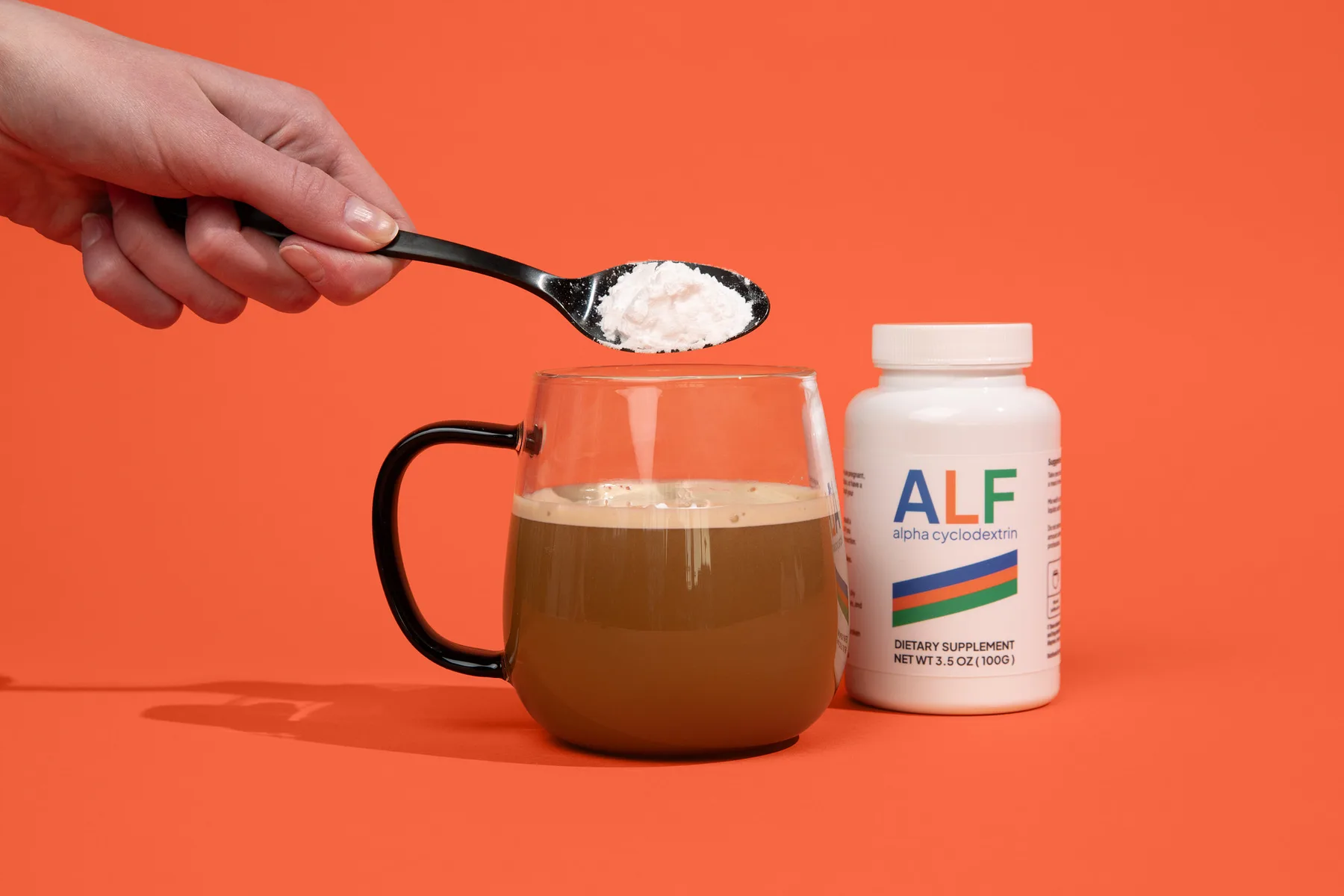
Alpha-cyclodextrin is a cyclic oligosaccharide, six glucose units arranged in a ring, derived from non-GMO plant starch through enzymatic biotransformation. Its structure is uniquely functional: hydrophilic on the outside (water-soluble), lipophilic on the inside (fat-attracting). This creates a molecular pocket capable of forming inclusion complexes with lipid molecules, effectively trapping dietary fats and shuttling them through the GI tract unabsorbed.
But α-CD is more than a fat binder. It’s a non-digestible, soluble fiber that reaches the colon intact, where it feeds beneficial microbiota and increases short-chain fatty acid (SCFA) production. Recent preclinical research suggests that α-CD may also stimulate GLP-1 secretion. In isolated cell models, α-CD increased GLP-1 release by up to 170% via adenylyl cyclase, phospholipase C, and L-type calcium channel-dependent pathways, with a more modest 20% increase observed in isolated rat colon perfusions (Sciascia et al., 2024). These are early-stage findings that require human clinical validation, but the direction is promising.
In plain terms: α-CD supports how your body handles fat, helps regulate blood sugar, feeds the gut microbiome, and may positively influence one of the most important metabolic signaling peptides your body produces naturally.
The Science: How Cyclodextrins Interact With Peptides
The relationship between cyclodextrins and peptides is well-documented in pharmaceutical research, even if it hasn’t yet penetrated the biohacking conversation as of March 2026, at time of writing.
Inclusion Complex Formation
Cyclodextrins form “host-guest” inclusion complexes with hydrophobic regions of peptide molecules. While most therapeutic peptides are too large to be fully encapsulated by the α-CD cavity, their hydrophobic amino acid side chains (aromatic residues like phenylalanine and tryptophan, and aliphatic residues like leucine) can insert into the cyclodextrin ring through van der Waals interactions. This partial encapsulation has several downstream effects:
- Improved stability: Cyclodextrin complexation reduces peptide susceptibility to enzymatic degradation. A study on the tripeptide glutathione demonstrated that degradation was reduced by approximately 50% within two hours when complexed with α-CD (Loftsson & Brewster, 2006).
- Protection from aggregation: Cyclodextrins prevent peptide aggregation, a common failure mode for peptides stored in solution, by shielding the hydrophobic surfaces that drive clumping.
- Enhanced solubility: The hydrophilic exterior of the cyclodextrin ring increases the aqueous solubility of peptide complexes, improving bioavailability in biological fluids.
Absorption Enhancement
Cyclodextrins have been studied extensively as absorption enhancers for peptide drugs, particularly through mucosal routes. They temporarily and reversibly increase membrane permeability without damaging tissue, a safer profile than many conventional absorption enhancers. Research in nasal peptide delivery showed that cyclodextrins improved bioavailability while having only a “moderate, reversible, and less dangerous influence” on mucosal tissues compared to other enhancers (Merkus et al., 1999).
The GLP-1 Connection
One of the more intriguing recent findings involves α-CD’s potential to stimulate endogenous GLP-1 release. GLP-1 (glucagon-like peptide-1) is a 30-amino acid incretin hormone that regulates insulin secretion, appetite, and gastric emptying, the same target that drugs like semaglutide (Ozempic) and tirzepatide (Mounjaro) are designed to activate. A 2024 study found that luminal α-CD increased GLP-1 secretion by 20% in isolated rat colon perfusions, with even more dramatic effects in cell models (up to 170% increase), suggesting that α-CD may act as a natural GLP-1 secretagogue when it reaches the colon. (Note: these are preclinical findings; human trials are needed to confirm the magnitude of this effect.)
For peptide users, this is significant: you’re already investing in exogenous peptide signaling. α-CD may amplify your body’s own peptide production alongside your protocol.
Popular Peptide Stacks and Where ALF Fits In
Here’s where this gets practical. Let’s walk through the most widely used peptide stacks and examine how daily α-CD supplementation with ALF could complement each one.
The Wolverine Stack: BPC-157 + TB-500
What it is: The Wolverine stack pairs BPC-157 (Body Protection Compound-157, a 15-amino acid gastric peptide) with TB-500 (a synthetic fragment of thymosin beta-4). BPC-157 is known for its effects on angiogenesis, tendon and ligament repair, and gut healing. TB-500 supports cell migration, reduces inflammation systemically, and promotes tissue remodeling.
Typical use: Injury recovery, joint repair, tendon healing, post-surgical recovery. BPC-157 is often dosed at 250-500 mcg/day subcutaneously, with TB-500 at 2-5 mg/week in a loading/maintenance cycle.
Where ALF fits:
- Gut environment optimization. BPC-157 is derived from gastric juice proteins and has well-documented gut-healing properties. α-CD’s role as a prebiotic fiber, feeding colonic bacteria and increasing SCFA production, creates a healthier intestinal environment that may support BPC-157’s own gut-protective mechanisms. Think of it as preparing the soil before planting.
- Inflammation reduction from both ends. The Wolverine stack targets tissue-level inflammation. α-CD addresses metabolic inflammation at the systemic level by reducing postprandial lipid spikes and improving glycemic control. Less metabolic noise may mean a better overall environment for your wellness protocol.
- Fat metabolism support. TB-500 and BPC-157 don’t directly address body composition. α-CD’s fat-binding capacity (preferentially targeting saturated and trans fats) and GLP-1 stimulation provide a complementary metabolic layer, managing the dietary inputs while the peptides handle tissue repair.
The GLOW Stack: BPC-157 + TB-500 + GHK-Cu
What it is: GLOW builds on the Wolverine stack by adding GHK-Cu (glycyl-L-histidyl-L-lysine copper complex), a tripeptide naturally found in human plasma that declines with age. GHK-Cu drives extracellular matrix remodeling, collagen synthesis, elastin production, and acts as a potent antioxidant. The combination targets both deep tissue repair (BPC-157 + TB-500) and surface-level rejuvenation (GHK-Cu).
Typical use: Anti-aging, skin rejuvenation, wound healing, hair restoration, and comprehensive tissue recovery. GHK-Cu is typically dosed at 1-2 mg/day subcutaneously.
Where ALF fits:
- Collagen synthesis support. GHK-Cu stimulates collagen production, but collagen synthesis is metabolically expensive and nutrient-dependent. α-CD’s improvement of nutrient absorption efficiency and gut health helps ensure the raw materials for collagen production are being properly assimilated.
- Antioxidant synergy. GHK-Cu has documented antioxidant and anti-inflammatory gene expression effects. α-CD’s production of short-chain fatty acids (especially butyrate) in the colon has its own anti-inflammatory and antioxidant downstream effects, a complementary pathway that reinforces what GHK-Cu is doing at the cellular level.
- Metabolic foundation for rejuvenation. Anti-aging protocols work best when the underlying metabolic environment is healthy. α-CD’s effects on blood sugar regulation, fat metabolism, and gut microbiome composition create a cleaner metabolic baseline, the kind of foundation that supports any wellness-oriented protocol.
The KLOW Stack: BPC-157 + TB-500 + GHK-Cu + KPV
What it is: The KLOW blend adds KPV (lysine-proline-valine), a tripeptide derived from alpha-MSH (alpha-melanocyte stimulating hormone). KPV has potent anti-inflammatory properties, particularly in the gut, where it modulates NF-κB signaling and has shown benefits in models of inflammatory bowel disease.
Typical use: Gut inflammation, IBD/IBS support, immune modulation combined with tissue repair and anti-aging.
Where ALF fits:
- Gut-first synergy. KPV’s gut anti-inflammatory action and α-CD’s prebiotic fiber effects are directly complementary. KPV works on immune-mediated inflammation; α-CD works on the microbial and metabolic side. Together, they address gut health from two distinct and reinforcing angles.
- Microbiome modulation. α-CD reaches the colon where it’s fermented by beneficial bacteria, shifting microbiome composition and SCFA production. This creates a more favorable environment for KPV’s anti-inflammatory signaling to take effect.
- Reduced GI irritation. Some peptide users report mild GI discomfort during protocols. α-CD as a gentle, well-tolerated fiber may help buffer digestive disturbances while supporting regularity.
Growth Hormone Secretagogue Stacks: CJC-1295 + Ipamorelin
What it is: CJC-1295 (a GHRH analog) paired with Ipamorelin (a selective ghrelin receptor agonist) is the most common growth hormone (GH) secretagogue stack. Together, they stimulate pulsatile GH release for body composition improvements, recovery, and anti-aging.
Where ALF fits:
- Metabolic alignment. GH secretagogues work best in a fasted or low-insulin state. α-CD’s fat-binding and blood sugar-stabilizing properties help create flatter glucose curves throughout the day, which supports the metabolic window these peptides need to be effective.
- Body composition stacking. If you’re using GH secretagogues for fat loss and lean mass, α-CD’s fat-binding action is a direct dietary complement by reducing caloric absorption from fats while the peptides optimize hormonal signaling for body composition.
- GLP-1 amplification. GLP-1’s effects on appetite suppression and insulin sensitivity align well with the goals of a GH secretagogue protocol focused on recomposition.
How to Use ALF Alongside Your Peptide Protocol
ALF is designed for simplicity. Here’s a straightforward integration approach:
Timing: Take ALF capsules (or mix the bulk powder) with your largest fat-containing meal of the day. α-CD needs dietary fat present to form its inclusion complexes; this is when it does its best work.
Dosing: Follow the standard ALF dosing on the label. Most research on α-CD uses 2-3 grams daily, split across meals. The 120-capsule supply is formulated for convenient daily use.
Consistency: Like your peptide protocol, α-CD works best with daily consistency. The microbiome and GLP-1 effects are cumulative; they build over weeks of regular use.
No interference with injections: α-CD is an oral fiber supplement. It operates in the gut and does not compete with, bind to, or interfere with subcutaneously injected peptides, which enter the bloodstream directly and bypass the GI tract entirely.
The Research at a Glance
| Finding | Source |
|---|---|
| α-CD increases GLP-1 secretion up to 170% in cell models | Sciascia et al., Food Chemistry, 2024 |
| α-CD reduces dietary fat absorption via inclusion complex formation | Comerford et al., Obesity, 2011 |
| Cyclodextrin complexation reduces glutathione peptide degradation ~50% | Loftsson & Brewster, European Journal of Pharmaceutical Sciences, 2006 |
| α-CD reduces postprandial glucose excursions | Buckley et al., Current Diabetes Reports, 2022 (meta-analysis) |
| Cyclodextrin-grafted polymers provide 3x delay in peptide enzymatic degradation | Matencio et al., Polymers, 2020 |
| Cyclodextrins serve as safe, reversible absorption enhancers for peptide drugs | Merkus et al., Pharmacy World & Science, 1999 |
The Bottom Line
Peptide protocols are precision tools. But precision tools perform best in an optimized environment. Alpha-cyclodextrin as delivered by ALF Labs addresses the metabolic, digestive, and inflammatory foundations that determine how well your body responds to peptide signaling.
You’re not adding complexity to your stack. You’re adding a single, plant-based fiber that:
- Binds dietary fats and smooths glucose curves
- Stimulates your body’s own GLP-1 production
- Feeds beneficial gut bacteria and increases SCFAs
- Has documented peptide-protective properties at the molecular level
Whether you’re running Wolverine for recovery, GLOW for anti-aging, or CJC/Ipa for recomposition, ALF is the foundational metabolic layer designed to complement your protocol.
Science and simplicity. That’s the ALF approach.
Disclaimer: This article is for informational and educational purposes only and is not intended to diagnose, treat, cure, or prevent any disease. Peptides such as BPC-157, TB-500, GHK-Cu, KPV, CJC-1295, and Ipamorelin are not FDA-approved for human therapeutic use and are available for research purposes only. Alpha-cyclodextrin is a dietary fiber with GRAS (Generally Recognized As Safe) status. ALF Labs does not sell, endorse, or make therapeutic claims about peptide therapies, and makes no claim that alpha-cyclodextrin treats or replaces any medical treatment. Always consult with a qualified healthcare provider before beginning any supplement or peptide protocol.
Related reading