
CYCLODEXTRIN 101
What is Cyclodextrin?
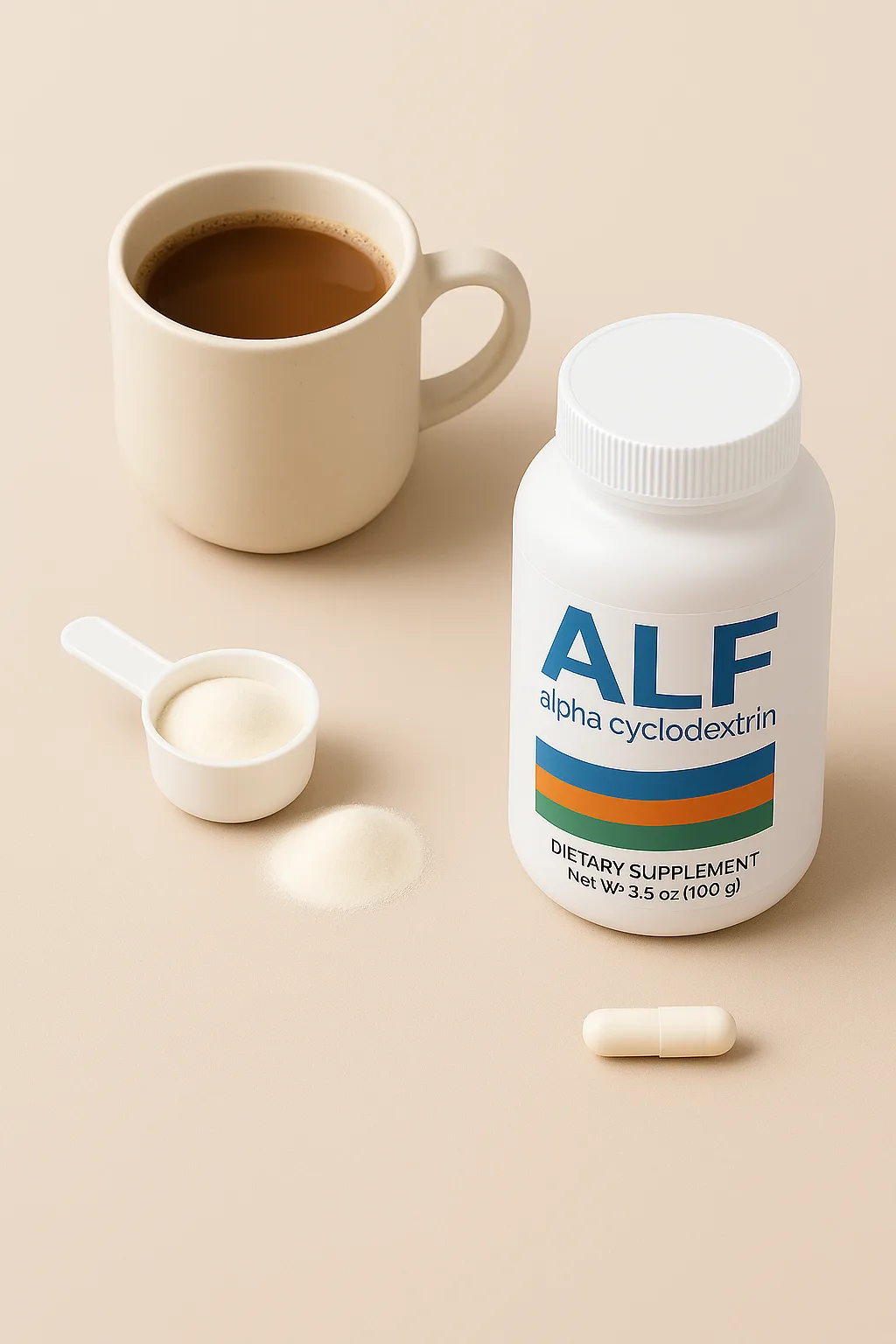
Cyclodextrin is a name that shows up in supplement labels, pharmaceutical formulations, and even food packaging, but most people have never had it explained in plain terms. Here’s the short version: a cyclodextrin is a ring-shaped sugar molecule, built from glucose units joined end to end into a closed loop, with a structure that lets it do things ordinary sugar chains can’t.
The Basic Chemistry
Chemically, a cyclodextrin is a cyclic oligosaccharide, a small number of sugar units linked together in a circle rather than a straight chain. That ring shape is what gives cyclodextrins their unusual properties. The outer surface of the ring is covered in hydroxyl groups, making it water-soluble, while the interior forms a hollow, non-polar cavity capable of temporarily holding smaller, fat-attracting molecules. This structure is why cyclodextrins are used across such a wide range of industries, from drug delivery to food formulation, wherever there’s a need to stabilize, protect, or carry a fat-soluble compound in a water-based environment.
The Alpha, Beta, and Gamma Family
Cyclodextrins aren’t a single molecule, they’re a family, distinguished by how many glucose units make up the ring.
Alpha cyclodextrin is the smallest member of the family, built from six glucose units. Beta cyclodextrin has seven, and gamma cyclodextrin has eight. Each size creates a cavity of a different diameter, which changes what kind of molecules it can effectively bind.
Beta cyclodextrin is the most widely used industrially, largely because it’s the least expensive to produce at scale, and it shows up in everything from odor-control products to pharmaceutical excipients. Alpha cyclodextrin, being the smallest and having the tightest ring structure, is the family member most relevant to fiber and fat-binding applications, since its cavity size and its resistance to digestive enzymes are what let it function as a fiber in the human gut rather than being broken down like an ordinary starch.
| Alpha Cyclodextrin | Beta Cyclodextrin | Gamma Cyclodextrin | |
|---|---|---|---|
| Ring size | 6 glucose units | 7 glucose units | 8 glucose units |
| Common use | Dietary fiber, fat-binding | Industrial and pharmaceutical carrier | Larger-molecule encapsulation |
| Water solubility | High | Moderate | High |
Where You’ll Find Cyclodextrins
Cyclodextrins show up in more places than most people realize, precisely because that dual water-loving, fat-loving structure is so useful. In pharmaceuticals, cyclodextrins are used to improve the solubility and stability of poorly water-soluble drugs, letting formulators deliver compounds that would otherwise be difficult to dissolve in the body. In food manufacturing, they’re used to stabilize flavors, mask unwanted odors, and protect sensitive compounds like certain vitamins from breaking down during storage. In consumer products, you’ll find cyclodextrins in odor-neutralizing sprays, where the ring traps odor molecules the same way it traps dietary fat.
Dietary fiber is a newer and more specific application, one that depends heavily on which member of the cyclodextrin family you’re using. Not every cyclodextrin is well suited to being a fiber ingredient. The molecule needs to resist human digestive enzymes long enough to reach the colon intact, and it needs a cavity sized appropriately for the fat molecules it’s meant to bind. That’s a fairly narrow set of requirements, and it’s part of why alpha cyclodextrin, rather than beta or gamma, is the one used in fiber-focused products like ALF.
The ALF Difference
ALF Labs uses alpha cyclodextrin exclusively, sourced from non-GMO corn starch and produced through a fermentation process carried out in Germany. That fermentation-based manufacturing approach is what converts ordinary plant starch into the closed-ring structure that defines alpha cyclodextrin, using enzymes to reshape the starch chain into its final circular form.
ALF’s alpha cyclodextrin is available in two formats: a bulk powder that dissolves clear in hot or cold drinks, and capsules for a simpler grab-and-go option. Both formats deliver the same underlying ingredient; the choice comes down to which fits more naturally into your day.
How to Use It
Getting started is simple: a standard serving is 3 grams of powder, or 3 capsules, taken with a meal, ideally one that includes some dietary fat, since that’s when alpha cyclodextrin does its fat-binding work. The powder mixes into coffee, tea, or water without adding any taste, and the capsules can be taken with a glass of water alongside food.
Quality and Safety
ALF’s alpha cyclodextrin is manufactured under quality-controlled conditions and purity-tested to confirm it meets the standard expected of a food-grade functional fiber ingredient. Every production batch goes through this same testing process before it’s packaged, so the powder or capsule you’re using is consistent with the batch before it, rather than varying from one production run to the next.
Understanding the chemistry behind the ring is interesting on its own, but what matters day to day is that it’s a well-characterized, purity-verified ingredient built to do one job consistently: fit cleanly into your routine as a functional fiber, whether that’s a scoop stirred into your morning coffee or a few capsules taken with lunch.