
CYCLODEXTRIN 101
What Is Cyclodextrin? A Clear and Simple 101 Guide
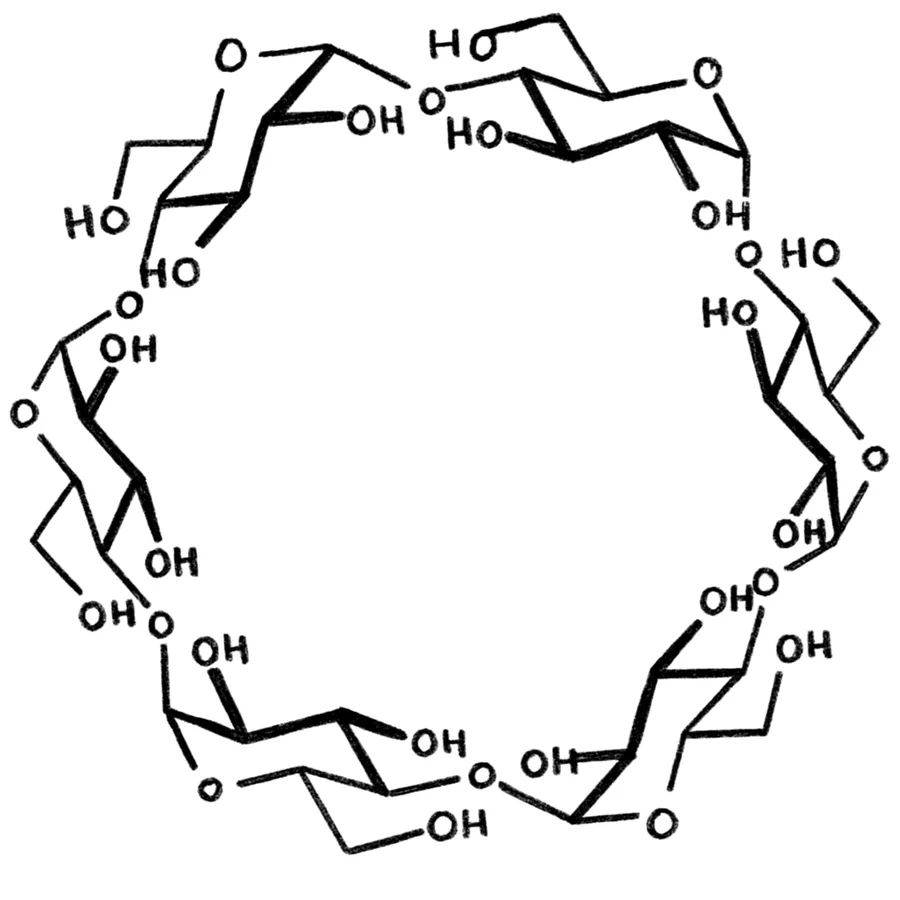
If you’ve come across the word “cyclodextrin” and wondered what it actually is, this guide is meant to answer that in plain language, starting with the mechanism, moving through what it may do for you, and ending with what to actually expect from a product like ALF.
The Mechanism: A Ring That Traps Fat
Picture a small ring, built from a handful of glucose units joined together in a circle rather than a straight chain. Chemists call this a cyclic oligosaccharide. That ring has an unusual property: its outer surface is covered in hydroxyl groups and is water-loving, so it dissolves easily in a drink, while the hollow space inside the ring is non-polar and fat-attracting. When that ring encounters a dietary fat molecule of the right size and shape during digestion, the fat molecule can slide into the hollow interior and get held there, forming what chemists call an inclusion complex.
Once trapped inside the ring, that fat travels differently through the digestive system than it normally would. The complex is bulkier and behaves more like a fiber than a free fat molecule, so a portion of the fat that would otherwise be broken down and absorbed continues through the gut without being absorbed in the usual way. That’s the entire mechanical story behind why cyclodextrin, and alpha cyclodextrin specifically, is used as a fat-binding fiber ingredient.
Why It Resists Digestion
A natural follow-up question: if alpha cyclodextrin is made from glucose, why doesn’t the body just digest it the same way it digests bread or rice? The answer is in the shape, not the raw materials. The enzymes your body uses to break down starch, amylase in your saliva and pancreas, are built to recognize and cut a specific kind of bond along an open, straight chain of glucose units. Alpha cyclodextrin’s glucose units are locked into a closed ring, and that ring geometry doesn’t fit into amylase’s active site the way an open starch chain does.
The practical result is that alpha cyclodextrin passes through your mouth, stomach, and small intestine largely untouched by digestion. It isn’t until it reaches the colon that bacteria living there produce the enzymes capable of opening the ring and fermenting it, the same place most other well-tolerated soluble fibers are broken down. This is exactly what allows alpha cyclodextrin to do its fat-binding work throughout the upper digestive tract instead of being absorbed as a simple sugar the way ordinary starch is.
If you want the wider context on where this sits among other fibers, our guide to the major fiber categories covers soluble, insoluble, and functional fibers side by side.
Potential Benefits
Based on how the molecule behaves, alpha cyclodextrin is associated with a handful of structure and function benefits, worth stating plainly and modestly:
- Adds dietary fiber. As a non-digestible ring molecule, alpha cyclodextrin contributes to your daily fiber intake in a form that’s gentle and well tolerated by most people.
- May support how your body handles dietary fat. Through the inclusion-complex mechanism described above, alpha cyclodextrin may reduce the amount of fat absorbed from a given meal.
- Supports a feeling of digestive comfort. Because it’s not aggressively fermented in the upper gut the way some fibers are, many people find it easier on digestion than heavier fermentable fiber sources.
These are structure and function statements, describing how the ingredient behaves in the body, not claims about treating, curing, or preventing any disease.
The Cyclodextrin Family
Alpha cyclodextrin belongs to a small family of related ring molecules, differing mainly by how many glucose units make up the ring and how large the resulting cavity is.
| Type | Glucose units | Cavity size | Digestive resistance | Common use |
|---|---|---|---|---|
| Alpha cyclodextrin | 6 | Smallest | Highest | Dietary fiber, fat-binding |
| Beta cyclodextrin | 7 | Medium | Moderate | Industrial and pharmaceutical carrier |
| Gamma cyclodextrin | 8 | Largest | Lower | Larger-molecule encapsulation |
Alpha’s smaller cavity and tighter structure are exactly what make it the family member best suited to fiber and fat-binding applications in a supplement context. Beta cyclodextrin is the most widely used industrially, largely because it’s the least expensive to produce at scale.
One name worth separating out here is highly branched cyclodextrin, which sounds related but behaves nothing like alpha cyclodextrin. We break down why the two are entirely different molecules in a dedicated comparison.
Where You’ll Find Cyclodextrins
Cyclodextrins show up in more places than most people realize, precisely because that dual water-loving, fat-loving structure is so useful. In pharmaceuticals, cyclodextrins are used to improve the solubility and stability of poorly water-soluble drugs, letting formulators deliver compounds that would otherwise be difficult to dissolve in the body. In food manufacturing, they’re used to stabilize flavors, mask unwanted odors, and protect sensitive compounds like certain vitamins from breaking down during storage. In consumer products, you’ll find cyclodextrins in odor-neutralizing sprays, where the ring traps odor molecules the same way it traps dietary fat.
Dietary fiber is a newer and more specific application, one that depends heavily on which member of the family you’re using. Not every cyclodextrin is well suited to being a fiber ingredient. The molecule needs to resist human digestive enzymes long enough to reach the colon intact, and it needs a cavity sized appropriately for the fat molecules it’s meant to bind. That’s a fairly narrow set of requirements, and it’s part of why alpha cyclodextrin, rather than beta or gamma, is the one used in fiber-focused products like ALF.
How to Use It
ALF’s alpha cyclodextrin is available as a powder or as capsules, no other formats. A standard serving is 3 grams of powder, or 3 capsules, taken with a meal that includes some dietary fat so the fat-binding mechanism has something to work with. The powder is unflavored and dissolves clear in hot or cold drinks; the capsules are a simple option for anyone who’d rather skip mixing and just take them with water and food.
For timing, stacking, and mixing specifics, see the full guide to using alpha cyclodextrin.
Why Choose ALF
ALF sources its alpha cyclodextrin from non-GMO corn starch and manufactures it through a fermentation process based in Germany, a production standard that emphasizes consistency and traceability from raw material to finished ingredient. That fermentation-based approach is what converts ordinary plant starch into the closed-ring structure that defines alpha cyclodextrin, using enzymes to reshape the starch chain into its final circular form.
Every production batch is purity-tested to confirm it meets the quality bar expected of a food-grade functional fiber, and it goes through that same testing before packaging, so the powder or capsule you’re using is consistent with the batch before it rather than varying from one production run to the next.
Beyond sourcing, the practical profile of the ingredient is part of why ALF built its product line around it: it’s zero-calorie, zero-sugar, and essentially zero-taste, meaning it can be added to a daily routine, stirred into a drink or swallowed as a capsule, without changing how anything tastes or adding meaningful calories or sugar to your day. That combination of clean sourcing, a controlled manufacturing process, and a genuinely unobtrusive daily experience is the whole case for choosing ALF’s alpha cyclodextrin over a less well-characterized ingredient.
Cyclodextrin doesn’t need to stay a mystery ingredient buried in a supplement facts panel. Once you understand the ring shape, the fat-binding mechanism, and why alpha cyclodextrin in particular survives digestion long enough to matter, the rest is simple: pick powder or capsules, take it with a meal, and let a well-sourced, well-tested fiber do the quiet, consistent work it’s built for.
Related reading